The basic idea is simple. Biofuel from corn, soy, sugarcane, or trees has one big problem: it lives on land. It competes with food, forests, water, fertilizer, and biodiversity. Seaweed is different. It grows in the ocean. It needs no farmland and no freshwater. It grows fast, soaks up nutrients and carbon, and we have barely begun to domesticate it.
That is why macroalgae is exciting — and it is the bet behind Berkeley’s new International Bioeconomy & Macroalgae Center (IBMC) at the EBI. But the hard part was never the vision. It is the economics. One of the central challenges for the IBMC and the wider EBI is to prove that fuel can be made from seaweed both economically and sustainably — not on paper, but at a price the market will actually pay.
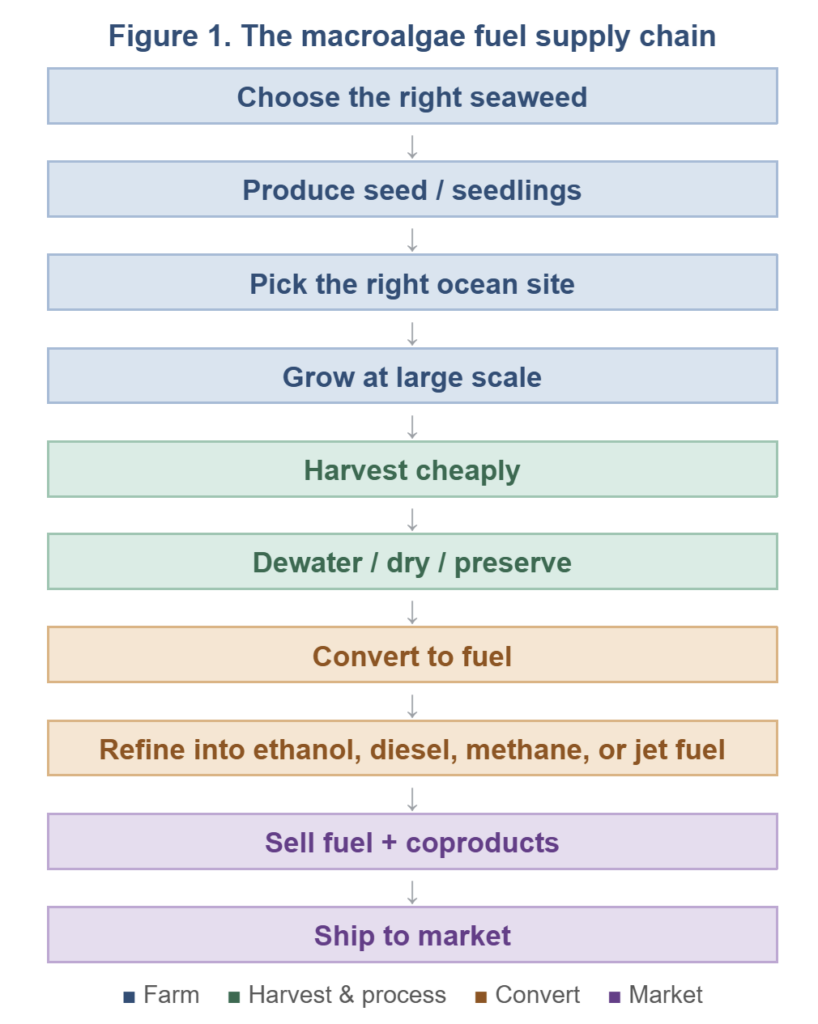
Today, at small scale, producing and delivering dry seaweed can cost close to $1,000 per dry ton or more. The serious goal is to move toward $100–$300 per dry ton, and lower still in the best tropical sites. That will not come from one magic invention. It will come from improving every step of the chain.
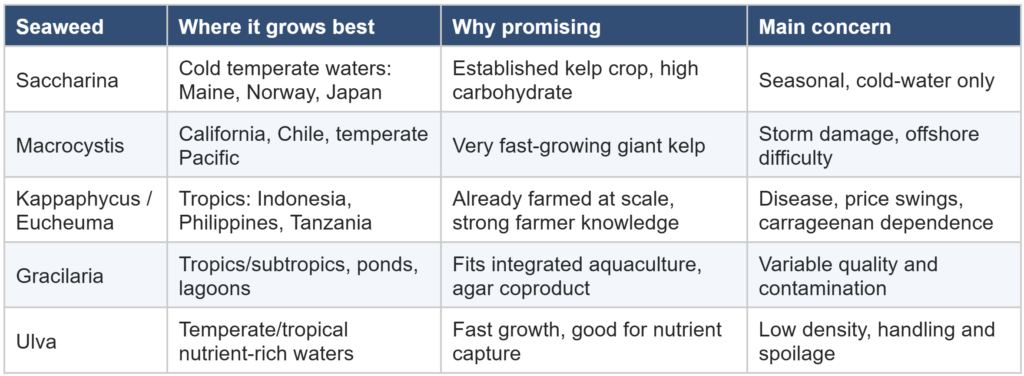
The first challenge is yield. We need seaweed that grows fast, survives storms, resists disease, and carries high fuel content. Macroalgae is not like oil-rich microalgae. It usually holds little oil — often just a few percent of dry weight. Its fuel value lives mostly in carbohydrates that can be fermented, digested, or chemically upgraded. So the target is not “make seaweed oily.” It is: increase total biomass, increase fermentable carbon, and cut ash and water.
Biotech can help. Selection, breeding, genomics, gene editing, microbiome management, and better hatcheries can plausibly lift field yield by 20–50% over today’s varieties, with perhaps another 10–30% more fermentable carbohydrate on top. Combine better biology with better farms and the fuel per hectare could roughly double. That is the kind of goal Berkeley should chase: not a miracle, but a measurable gain.
The second challenge is harvesting cost. Seaweed is heavy because it is wet, and moving water is expensive. The fix is to design farms for machines from day one: floating lines, modular nets, GPS-guided harvesters, barges that cut and collect continuously, and local depots that chop and press the crop on the spot. Labor-intensive harvest works for food and hydrocolloids. It will not work for fuel.
The third challenge is drying and processing. Sun-drying is cheap but slow and weather-dependent. Industrial drying is reliable but costly. For fuel, the best answer may be to skip full drying altogether — process it wet, using pressing, ensiling, fermentation, anaerobic digestion, or hydrothermal liquefaction. Put the refinery near the farm. Use waste heat, solar, or geothermal where you can. Don’t ship wet seaweed long distances without a very good reason.
The fourth challenge is disease. The more we scale, the more crop problems we meet: ice-ice disease, epiphytes, grazers, bleaching, bacteria, and viruses. This is normal agriculture. It calls for seaweed pathology, resistant strains, monitoring, and insurance. The ocean farm of the future will be watched by sensors, drones, satellites, and local farmers with phones.
The fifth challenge is fuel value. Commodity road fuel is hard because it is cheap. Aviation fuel is more interesting, because low-carbon jet fuel earns a premium. Seaweed can become ethanol and then jet fuel, methane for shipping, biocrude through hydrothermal liquefaction, or renewable diesel after upgrading. Aviation may be the best early target: airlines need low-carbon fuel and have fewer alternatives than cars.
But fuel alone is probably not enough. The business model should be a biorefinery. Pull out the high-value products first — biostimulants, fertilizer, feed ingredients, agar, carrageenan, alginate, proteins, minerals, pigments, even bioplastics — then convert what remains to fuel. The fuel gives scale; the coproducts give profit.
Berkeley’s two field sites pull in different directions. Moorea is the learning lab: warm water, reefs, boats, field stations, students, and a real marine system to test ecology, disease, sensors, small farms, community acceptance, and tropical processing. Indonesia is the scale lab — millions of people already connected to seaweed, good weather, long coastlines, and deep farmer knowledge. The aim is not to replace those farmers with machines, but to help them earn more through better seedlings, quality, processing, logistics, and market access.
Berkeley’s real strength is that it can assemble the whole system — biology, engineering, economics, policy, law, data science, ocean science, and strong industry links. To win, the IBMC needs a few focused hires: a macroalgae geneticist, an ocean-farming engineer, a bioprocess and refining engineer, a marine disease expert, and a supply-chain economist.
Corporate sponsors should bring more than money — problems, test sites, equipment, offtake agreements, and scale. Energy firms can help with refining, airlines with fuel demand, aquaculture firms with farms, shippers with logistics, and food, feed, and materials companies can buy the coproducts.
The goal is not simply to grow seaweed. It is to build a new blue supply chain — seed to fuel to coproducts — that is cheaper, cleaner, and good for coastal communities. For the IBMC and the EBI, the defining test is the one we opened with: can seaweed make fuel both economically and sustainably? Meet that test, and the rest follows. That is the Berkeley opportunity.